

How can agentic AI move beyond proof‑of‑concepts and create real value in regulated life science environments?
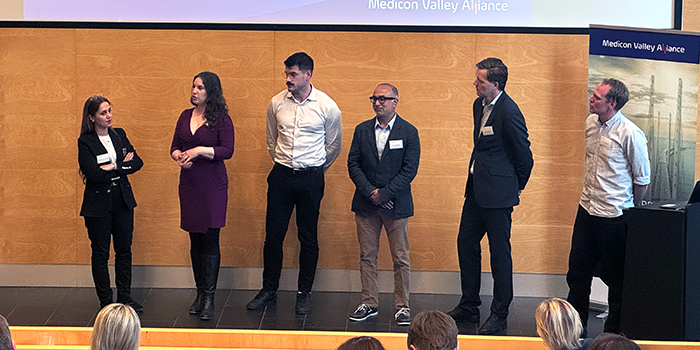
This question was at the centre of last weeks MVA R&D Network seminar on Agentic AI, which brought together experts from academia, industry, biotech, pharmatech and investment to explore how agentic AI is reshaping life science R&D.
Agentic AI represents the next evolution of artificial intelligence – systems that can reason, plan, use tools and execute complex workflows with human oversight. Throughout the seminar, speakers explored what it takes to move agentic AI from promising concepts into trusted, production‑ready solutions in highly regulated settings.
From foundations to value creation
The seminar opened with Sonja Aits (Lund University), who introduced the foundations of agentic AI and its evolution from predictive and generative systems to autonomous agents. A key message was that successful implementation requires robust orchestration, governance frameworks and human‑in‑the‑loop design to ensure control, transparency and trust.
From an investor perspective, Aleksandra Zaniewska (BioInnovation Institute, BII) highlighted the importance of moving beyond hype. She emphasized that value creation increasingly depends on AI systems that own real workflows, demonstrate regulatory literacy and deliver measurable outcomes rather than stand‑alone technical capabilities.
Agentic AI in clinical and regulated environments
Raja Shankar (IQVIA) demonstrated how agentic AI can support and transform clinical development by integrating scientific, clinical and regulatory data. Agentic systems can help simulate scenarios, optimize trial design and support decision‑making in increasingly complex development pathways.
Focusing on implementation in R&D, Niels Buch Leander (PharmaRelations) discussed the transition from copilots to agents. He stressed that a workflow‑first mindset, clearly defined boundaries, accountability and governance are essential when deploying AI in regulated environments.
The challenge of scaling AI beyond pilots was addressed by Søren Thorup (Adalyon), who urged organizations to “kill the PoCs” and design agentic AI directly for production. His key message was that bounded autonomy, auditability and built‑in trust are prerequisites for scalable AI in pharmatech.
Practical use cases and operational impact
Providing concrete examples from industry, Masoumeh Vahedi and Alejandro Gonzalez (Genmab) presented how agentic workflows can be applied in regulated operations. Their cases showed how AI can turn documents and discussions into structured, traceable decisions using cognitive maps and human‑in‑the‑loop approaches – supporting both efficiency and compliance.
Security, privacy and governance in focus
In the concluding Q&A session, moderated by Stephen Lutsch (Genmab), participants engaged in an active discussion on security and privacy. The dialogue underlined that data protection, compliance and strong governance models are critical enablers for the responsible deployment of agentic AI in life science R&D.
The seminar highlighted that while agentic AI holds significant promise, real impact will depend on thoughtful implementation, clear accountability and a deep understanding of regulated workflows.